
Solutions / Van Conversions
Nobody wants to drill a factory van roof
A curved roof, limited area, and an owner who intends to sell the vehicle one day. Every hole is a sealed joint that has to stay sealed for years. Bonded bracket sets leave the roof skin intact.
Nobody wants to drill a factory van roof, and they are right not to. A van conversion has a curved roof, limited area, and an owner who intends to sell the vehicle one day. Every hole is a sealed joint that has to stay sealed for years, and a leak announces itself as a damp patch in the headlining long after you have forgotten where the hole was.
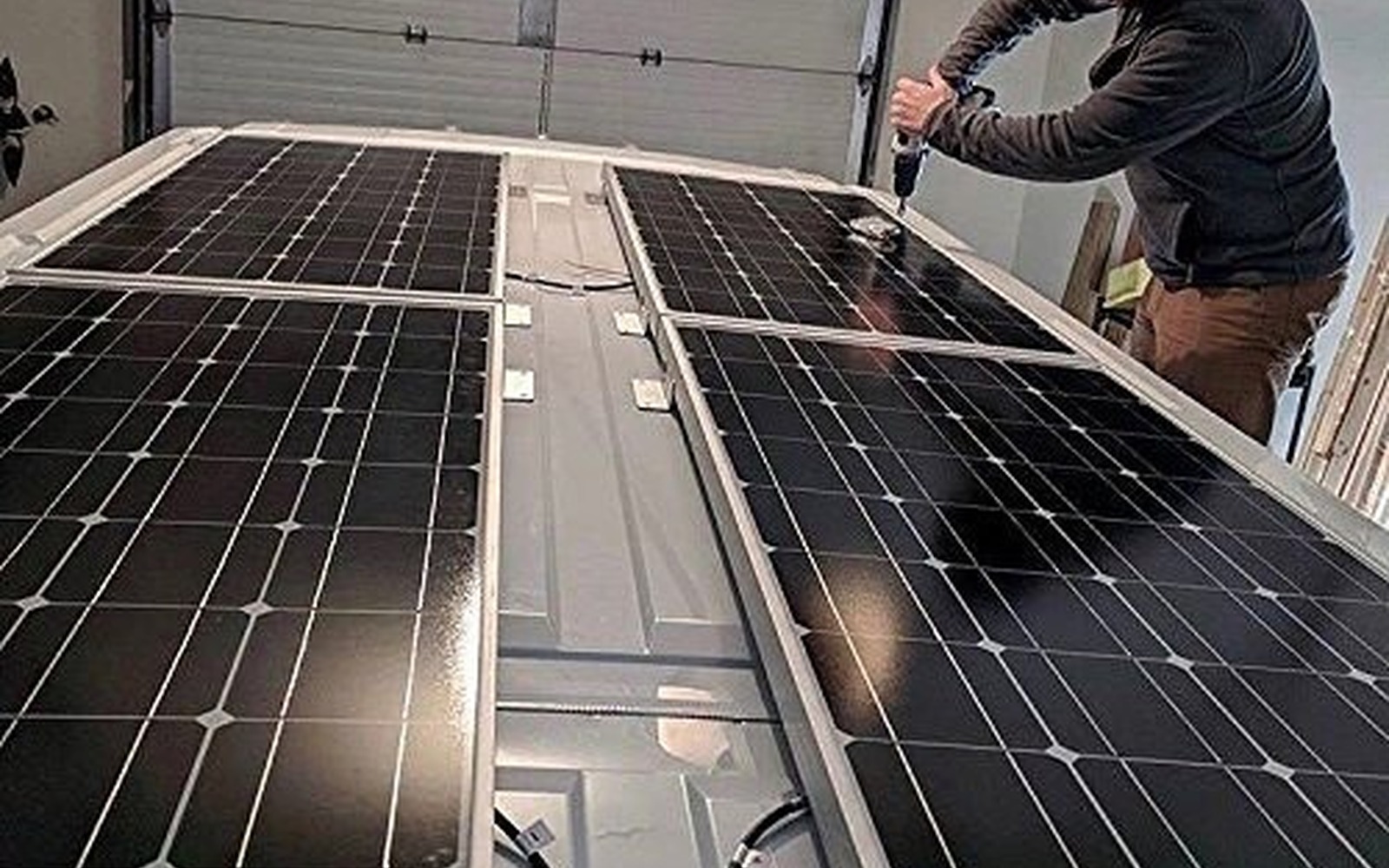
The challenge
- The roof is curved. A framed rigid panel needs a flat plane or a subframe. On most panel vans that means either spacers and complication, or a flexible laminate that follows the contour.
- The area is small and often shared with a roof fan or a hatch. What is left is a long narrow strip rather than a neat rectangle.
- Reversibility matters. This vehicle probably gets sold. Bonded brackets come off with adhesive residue; bolts leave holes that have to be declared.
What we would specify
For a van running a compressor fridge, lighting and device charging — the mainstream case, around 700 Wh/day:
- Panel — our 200 W ETFE flexible panel. 1500 × 680 mm, 4.5 kg, 3 mm thick. It follows the roof contour, adds no height at a car park barrier, and the ETFE front sheet resists UV markedly better than the cheaper PET alternative. If the usable strip is narrower, the 160 W or 110 W fill the gaps the catalogue sizes miss.
- Brackets — ABS bracket sets, 6 or 7 pieces for a panel this size. This is the part that makes the installation reversible — bonded to the roof, no penetration, and the panel lifts clear of the metal so it runs cooler.
- Controller — 30 A MPPT, good for up to 400 W at 12 V. Our PWM range is lithium-compatible too, but at 200 W and above MPPT recovers enough extra energy to pay for itself — most noticeably in cold, bright weather when the battery is low. On a build this size we would specify MPPT.
- Battery — 100 Ah LiFePO4 for a fridge-equipped van, or 40 Ah for weekend use without one.
- Cabling — a pre-made extension set sized for the run. Undersized cable on a long roof-to-controller run wastes output as heat, permanently.
The mistake that actually causes failures
It is not the mounting method — it is bonding the panel flat to the roof with no bracket at all. This is popular because it is quick, and it goes wrong twice: the laminate has nowhere to shed heat so output falls on exactly the days you were counting on it, and water and grit get under the edges and cannot dry out. Delamination follows in a couple of seasons and it is not repairable.
A bracket that lifts the panel a few millimetres solves both, routes the cabling underneath rather than across the roof, and lets you remove the panel later without destroying it. More on this in our guide to mounting without drilling.
Be realistic about winter
A 200 W panel on a converted van is a genuine power source from spring to autumn. In a northern European December, with a low sun angle, short days and a flat-mounted panel, it is a supplement — not a supply. If you travel year-round, either oversize the array, plan on alternator or hookup charging, or add a folding panel you can aim at what sun there is. Anyone who tells you otherwise is selling something.
Send us the van model, the usable roof strip and your load list and we will size it properly. Request a quotation →