
LiFePO4, unless the budget genuinely will not stretch or the van is stored somewhere that freezes. The headline price of lithium looks worse than lead-acid and the real cost is usually better, because you can actually use what you paid for.
The number that decides it: usable capacity
A 100 Ah battery does not give you 100 Ah. How much you can take out before you start damaging it is what matters, and this is where the two chemistries part company.
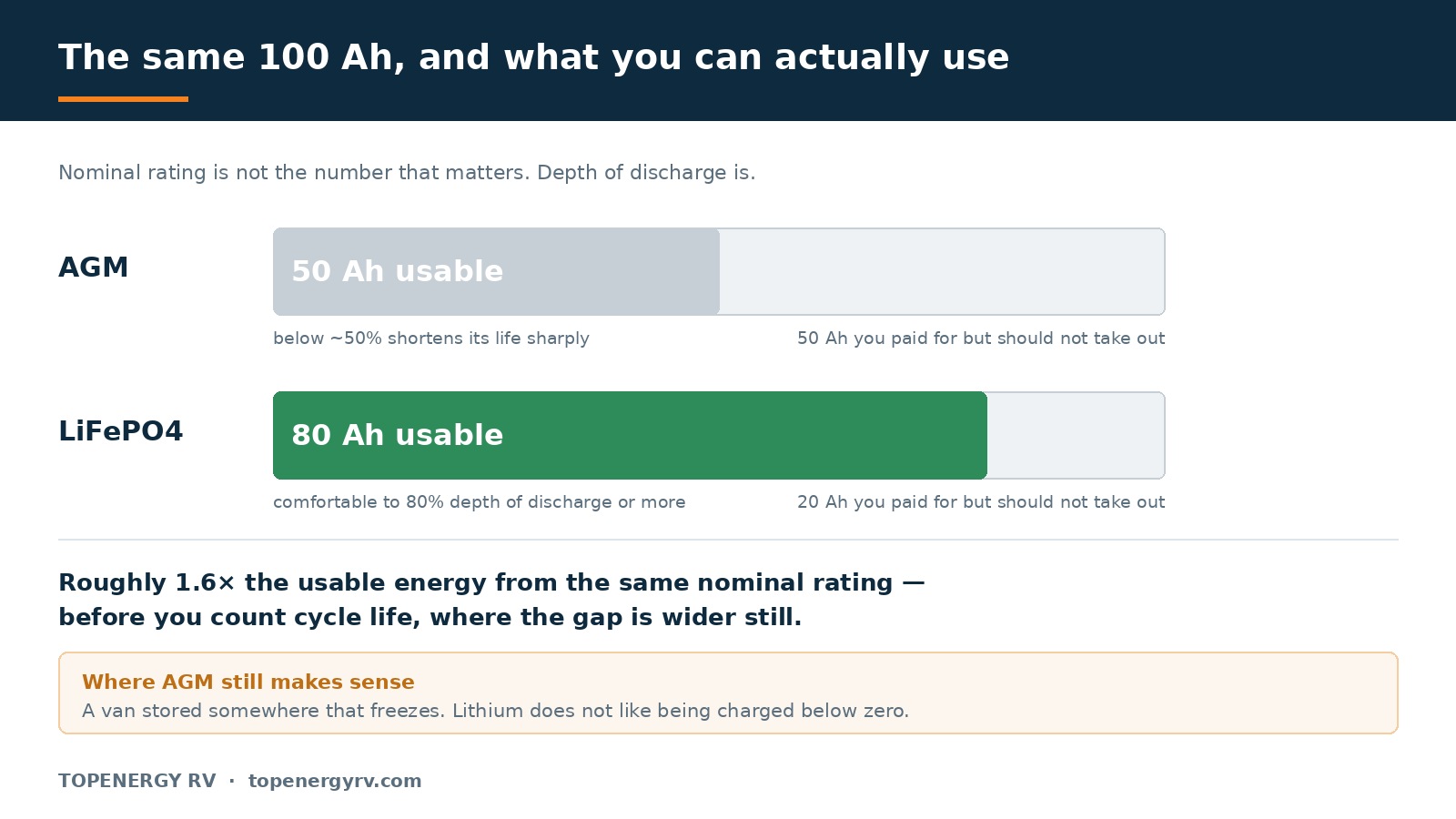
- AGM / lead-acid: routinely taking it below about 50% shortens its life sharply. So a 100 Ah AGM is realistically a 50 Ah battery.
- LiFePO4: comfortable down to 80% depth of discharge or more. A 100 Ah LiFePO4 is realistically an 80 Ah battery.
That is roughly 1.6× the usable energy from the same nominal rating — before you count cycle life, where the gap is wider still. Compare on usable amp-hours per unit of money over the life of the battery, not on the price tag, and lithium usually wins on a vehicle that gets used.
Weight, and why it matters more than people think
Lithium is roughly half the weight for the same usable energy. On a motorhome running close to its plated weight limit — which is more common than owners like to admit — that is not a nice-to-have. Payload is a legal limit, not a suggestion, and batteries are dense.
Where AGM still makes sense
- The van is stored somewhere that freezes. This is the real limitation of lithium: charging LiFePO4 below 0 °C damages it. Discharging in the cold is fine; charging is not. Many batteries have BMS protection that simply refuses the charge, which is safe but means no solar input all winter. If the vehicle overwinters outdoors unheated, think carefully.
- The budget is fixed and small. A weekend van with lights and phone charging does not need lithium to be pleasant.
- The existing charging equipment is lead-acid only. Which brings us to the thing that catches people out.
⚠ The mismatch we see most often
A lithium battery on a controller that only supports lead-acid. The charge profiles are different — lead-acid charging holds an absorption voltage and then floats; lithium wants a different curve and does not want to be float-charged indefinitely. Feed a LiFePO4 battery a lead-acid profile and at best it never fills properly; at worst you shorten its life or trip the BMS repeatedly.
Our MPPT controllers handle lithium as well as lead-acid, and so do several of the PWM models. We do not claim it for the whole range, because we have not yet seen it in writing from the factory for every model — tell us the battery chemistry with your enquiry and we will confirm the right model in writing. What still matters is sizing: above roughly 200 W an MPPT model recovers meaningfully more energy, and the gap is widest in cold, bright conditions with a low battery — precisely when you are short. If you are pairing a lithium bank with anything other than our own controllers, check the charge profile before you buy: a lead-acid-only unit will never fill a LiFePO4 battery properly.
Sizing it
Work back from consumption, not from the shelf:
- Daily watt-hours ÷ 12 V ÷ 0.8 = amp-hours for one day of autonomy on lithium. Use 0.5 instead of 0.8 for AGM.
- Most people want two days, so double it.
- Check the battery’s maximum charge current against your array. A large array into a battery that will only accept a modest charge current is money spent on nothing.
A van with a compressor fridge lands around 700 Wh/day, which is roughly 75 Ah of lithium for one day, 150 Ah for two. Full arithmetic on the sizing page.
One thing to check before you ship
Lithium batteries are dangerous goods in transport. Any battery we quote comes with a UN 38.3 test report, an MSDS and the applicable transport classification document. If a supplier cannot produce these, the goods will not clear customs — and once the container is loaded that is your problem, not theirs.
Tell us your daily consumption, where the vehicle overwinters, and what controller you have or plan to buy — we will specify the pairing rather than sell you a battery and hope.
Have a question about your build?
Tell us the vehicle, the roof dimensions and your daily consumption. We will size the system and quote it — and say so if what you are asking for will not work.