
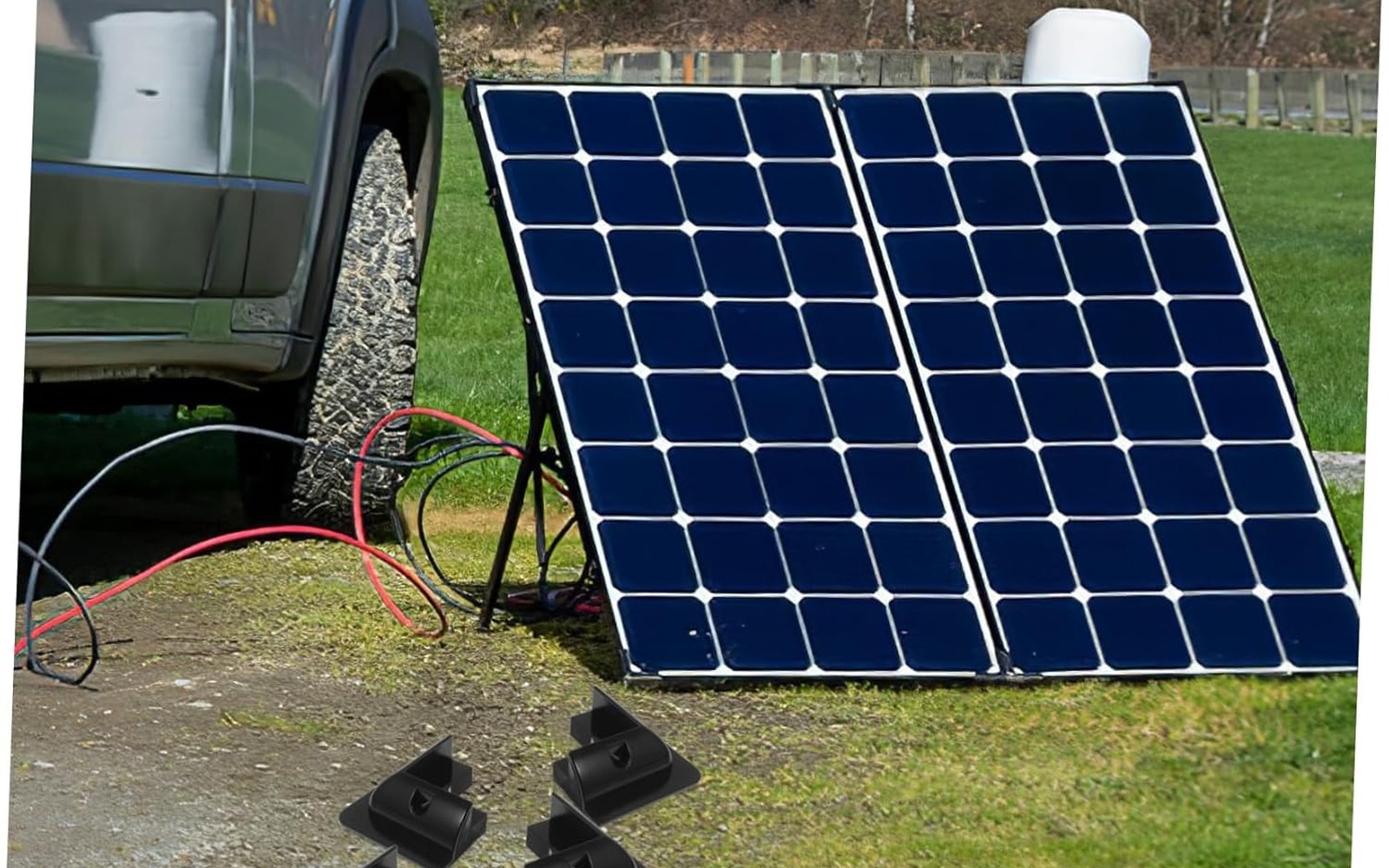
Work it out from what you use, not from how much roof you have. Three lines of arithmetic will get you to a sensible answer, and they will also tell you the thing most people get wrong: on a campervan the battery is usually the binding constraint, not the panel.
Step 1 — add up a day’s consumption
Watts × hours = watt-hours. Go through everything, honestly. A realistic weekend-van list looks something like this:
| Load | Power | Hours/day | Wh/day |
|---|---|---|---|
| Compressor fridge | 40 W | 10 (cycling) | 400 |
| LED lighting | 15 W | 4 | 60 |
| Water pump | 60 W | 0.3 | 18 |
| Phone / laptop charging | — | — | 120 |
| Diesel heater (shoulder season) | 20 W | 6 | 120 |
| Total | ≈ 720 Wh |
The fridge is almost always the largest single item, and it is the one people underestimate, because it does not run continuously — but in a hot van in August it runs a great deal more than it does in the specification sheet.
Step 2 — size the battery
Daily Wh ÷ 12 V ÷ 0.8 = amp-hours needed.
720 ÷ 12 ÷ 0.8 ≈ 75 Ah for one day of autonomy. The 0.8 is there because you should not routinely run a battery flat — and if you are using lead-acid or AGM rather than lithium, that figure should be 0.5, not 0.8, which roughly doubles the capacity you need. This is the single biggest practical advantage of LiFePO4: you can actually use most of what you paid for.
Most people want two days of autonomy so that one dull day does not end the trip. That takes this example to around 150 Ah.
Step 3 — size the panel
Battery Ah × 12 V ÷ 5 useful sun hours = watts needed to refill it in a day.
For 75 Ah: 75 × 12 ÷ 5 = 180 W. So a 200 W panel is the right size for this van — which is exactly why 200 W is the most common configuration we ship.
About that “5 sun hours”
This is the number that quietly ruins otherwise correct calculations. “Peak sun hours” is not daylight hours — it is the equivalent number of hours at full rated irradiance, and it varies enormously by latitude and season.
- Summer, southern Europe: five or more is realistic.
- Summer, northern Europe: around four on a good day.
- Winter, northern Europe: often nearer one. A short day, a low sun angle and heavy cloud combine badly.
A flat-mounted panel on a van roof also never sees the optimum angle, which costs you more in winter than in summer — the sun is low precisely when you are already short.
The practical consequence: a system sized for July will not carry you through December anywhere in northern Europe. If you travel year-round, either oversize the array substantially, plan on charging from the alternator or hookup, or accept that in midwinter solar is a supplement rather than a supply. Anyone who tells you a 200 W panel will run a van through a British January is selling something.
Sense-check the result
- Does it fit? Measure the roof between the obstacles, not the whole roof. Air conditioners, roof lights and vents take more space than expected.
- Can the battery take the current? A large array into a small battery is wasted; check the battery’s maximum charge current before finalising.
- Is the controller sized for the array? Above roughly 200 W, use MPPT — a PWM controller drops the panel to battery voltage and discards the difference.
- Two panels or one? Two smaller panels are often easier to place around roof furniture, and partial shading on one does not take down the whole array.
Rough starting points
| Use | Typical daily load | Ballpark system |
|---|---|---|
| Weekend van, lights and phones, no fridge | ~150 Wh | 100 W + 50 Ah |
| Van with fridge, three-season use | ~700 Wh | 200 W + 100 Ah |
| Full-time, fridge plus laptops and heating | 1,500 Wh+ | 400 W + 200 Ah |
Send us your load list, your vehicle and the country you mainly travel in, and we will size it properly and quote it — including the brackets to suit the panels. If you would rather do the arithmetic yourself, it is all above; we have not hidden it behind a form.
Have a question about your build?
Tell us the vehicle, the roof dimensions and your daily consumption. We will size the system and quote it — and say so if what you are asking for will not work.