
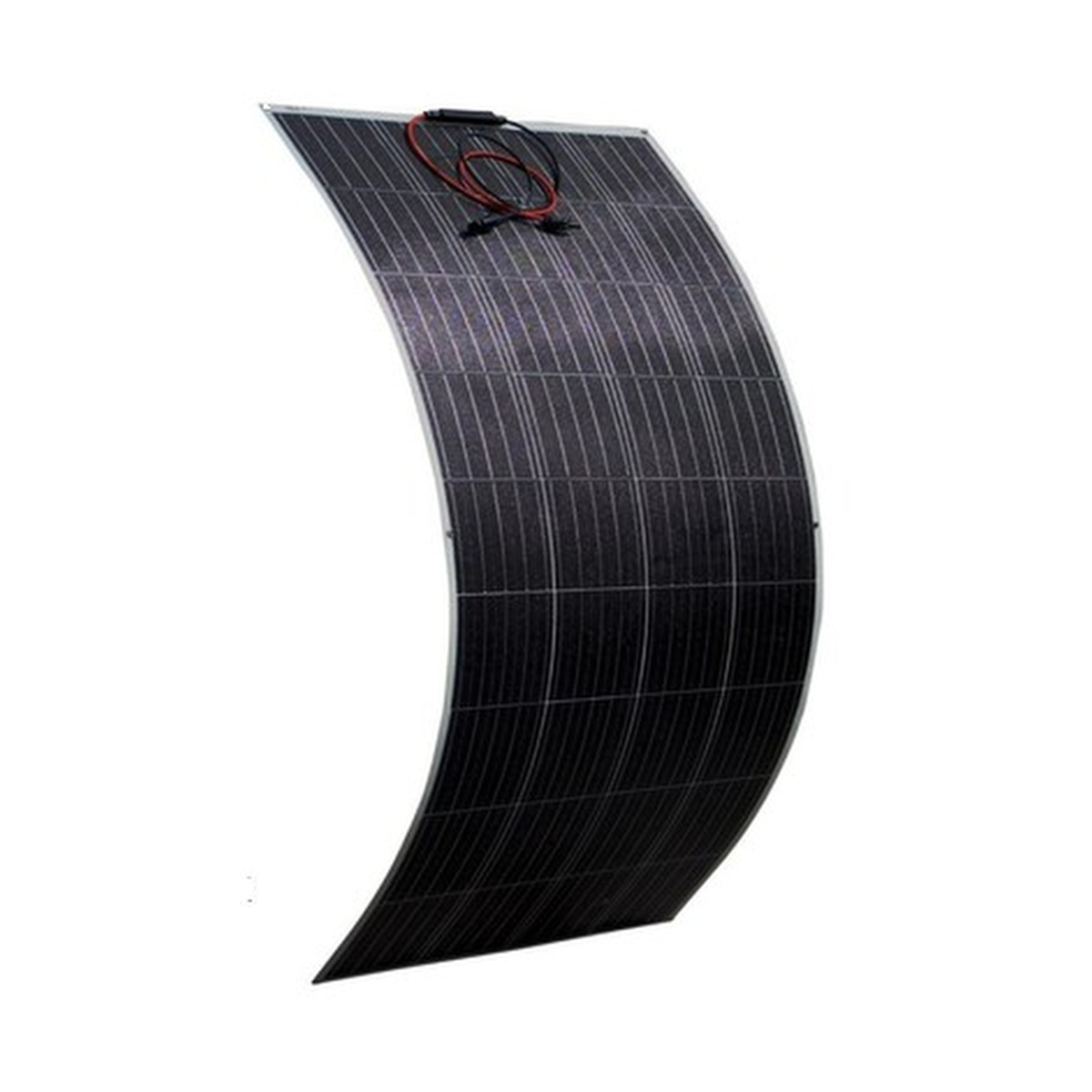
Around five to seven years on a vehicle roof — not twenty-five. The 25-year figure that appears on so many listings belongs to framed glass panels bolted to buildings. Applying it to a flexible laminate on a hot van roof is, at best, careless.
We sell flexible panels. We would still rather you knew this before buying than discovered it in year six.
Where 25 years comes from — and why it does not transfer
A conventional rooftop panel is silicon cells laminated behind tempered glass in an aluminium frame. The glass is an excellent barrier: it does not yellow, it does not let moisture through, and it holds its shape. Manufacturers back those with long performance warranties because the failure modes are well understood and slow.
A flexible panel replaces the glass and the frame with polymer layers — typically ETFE or PET over the cells, bonded to a backing. That is what makes it thin, light and able to follow a curved roof. It is also what limits its life:
- The front sheet ages. Polymers exposed to years of UV gradually haze and yellow. Less light reaches the cells. ETFE resists this considerably better than PET, which is the main reason it costs more.
- Heat accelerates everything. A dark van roof in summer is a brutal environment, and every degree above rated temperature both cuts output today and shortens life.
- Flexing has a cost. Silicon cells are rigid. Every heat cycle and every kilometre of vibration works the joints between cell and encapsulant. Microcracks accumulate and each one takes a small permanent bite out of output.
- Moisture ingress is the usual killer. Once water finds an edge or a puncture, it cannot dry out. Delamination follows — the cloudy patches and bubbles you see on old panels — and it is not repairable.
What you can do about it
Most of the difference between a panel that lasts three years and one that lasts seven is installation, not brand.
- Do not bond it flat to the roof. This is the big one. A panel with no airflow underneath runs far hotter, and heat is the accelerant for every failure mode above. Mount it on brackets that lift it clear.
- Seal the edges properly with neutral-cure silicone, and pay particular attention to where the cable exits. Most delamination starts at an edge.
- Do not walk on it. Obvious, routinely ignored on a van roof where the panel is the flattest thing up there.
- Avoid partial shading from aerials and roof lights where you can. A shaded cell becomes a resistor, gets hot, and ages faster than its neighbours.
- Choose ETFE over PET if the van sees real sun. On a vehicle that is stored under cover most of the year, PET is defensible. On a full-timer in southern Europe, it is a false economy.
So is a flexible panel the wrong choice?
Not at all — it is the right choice for a great many vans. It weighs a fraction of a framed panel, it follows a curved roof, it does not add height at the barrier of a car park, and it does not need a frame. Those are real advantages and for most conversions they outweigh the shorter life.
The point is to buy it knowing what you are buying. Budget for replacement in the second half of the decade rather than treating it as a once-in-a-vehicle-lifetime purchase. If your roof is flat, weight is not critical, and you want maximum life, a rigid panel on brackets is the longer-lived option and we will happily quote that instead.
How to read a supplier’s warranty
Two things worth separating when you compare offers:
- Product warranty — how long the supplier will replace a physically failed panel. This is the number that matters for a vehicle installation, and for flexible panels it is typically short.
- Performance warranty — a guaranteed output percentage after N years. The 25-year figures you see quoted are almost always this type, transplanted from rigid module datasheets.
If a listing advertises 25 years against a flexible laminate without distinguishing the two, treat everything else on that listing with the same scepticism.
Our own warranty terms are stated on each product page, and our bracket sets exist largely to keep panels off the roof surface — which is the cheapest thing you can do to make one last. Questions before you buy are welcome: ask us.
Have a question about your build?
Tell us the vehicle, the roof dimensions and your daily consumption. We will size the system and quote it — and say so if what you are asking for will not work.