
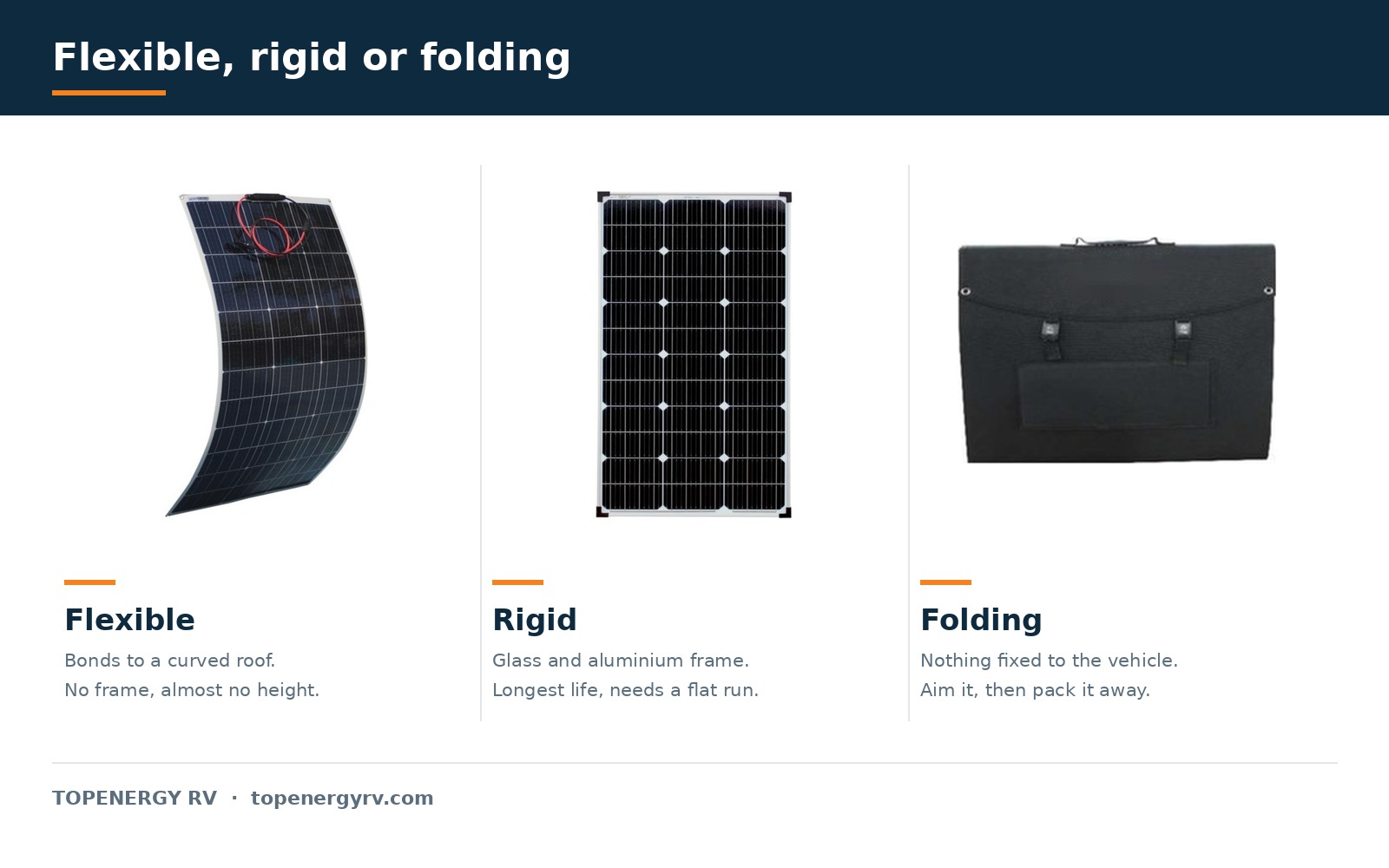
Flexible if the roof is curved or weight matters. Rigid if you want the longest life and the roof is flat. Folding if you would rather not attach anything to the vehicle at all. That is the short version, and for most builds it is enough. The rest of this page is why, and where the answer changes.
The honest comparison
| Flexible | Rigid | Folding | |
|---|---|---|---|
| Curved roof | Yes — this is what it is for | Needs a flat plane or subframe | Not mounted |
| Weight | Lowest — a few kg | Roughly twice as much for the same output | Carried, not mounted |
| Height added | A few mm on brackets | 30–35 mm frame plus mounts | None |
| Service life | Shortest — polymer front sheet ages | Longest — glass does not yellow | Short-to-medium; it lives in a bag |
| Warranty | 1 year full, 5 years output | 5 years full, 25 years output | 1 year full |
| Can be aimed | No | No | Yes — the whole point |
Flexible: the default for van conversions
A flexible panel is silicon cells laminated between polymer sheets instead of behind glass in a frame. That makes it thin, light and able to follow a contoured roof — and it is why most van conversions use them.
The trade-off is life. The front sheet is what ages: UV gradually hazes and yellows it, and less light reaches the cells. This is also where ETFE earns its price over PET — ETFE resists UV markedly better. On a vehicle stored under cover or used seasonally, PET is defensible. On a full-timer in southern Europe it is a false economy.
One rule matters more than the panel choice: do not bond it flat to the roof. A laminate lying on hot metal has nowhere to shed heat, produces less on exactly the days you needed it, and traps moisture that eventually delaminates it. Lift it on bracket sets. More on that in our guide to mounting without drilling.
Rigid: buy once
Glass front, aluminium frame, and a warranty a laminate cannot match — 5 years full and 25 years on output, against 1 and 5. Glass does not yellow and does not delaminate. A framed panel also sits proud of the roof with air underneath, so it runs cooler and loses less output on hot days.
The cost is weight and shape. A 160 W rigid panel weighs roughly twice its flexible equivalent, and it needs a flat mounting area. On a motorhome or caravan with a genuinely flat roof section, that is usually fine and the longer life wins. On a curved panel-van roof it is the wrong tool.
Back-contact: the newer option
Back-contact cells move the electrical contacts to the rear of the cell. Nothing shades the front, and the panel reads as a clean black rectangle rather than a grid of silver busbars. If the roof is visible and the build is a considered one, it looks the part in a way a standard panel does not. Ask us how it compares for your case — we are still assembling the full technical data on this range.
Folding: power you carry
A folding panel attaches to nothing. It unfolds, props up, and — critically — can be aimed at the sun. A roof panel lies flat and takes whatever the sky gives it; a portable panel angled correctly can meaningfully out-produce a roof panel of the same rating, especially in winter when the sun sits low.
It also solves the problem no roof array can: park in the shade, put the panel in the sun. On a hot afternoon that is the difference between a comfortable van and a hot one.
The costs are honest ones — you have to deploy and stow it every time, it takes locker space, and it can be stolen. Most people who own one use it alongside a roof array rather than instead of it.
So which one
- Panel van conversion, curved roof, will not drill → flexible on bonded brackets. The mainstream answer.
- Motorhome or caravan with a flat roof section, weight not critical → rigid, for the warranty and the cooler running.
- Vehicle you cannot modify — rental, lease, company van → folding.
- Travelling through winter → whatever is on the roof, plus a folding panel you can aim. Do not expect a flat-mounted array to carry a northern European December.
- Roof appearance matters → back-contact.
If you are still deciding, tell us the vehicle and how you use it rather than which panel you want — we will tell you which type fits, including when the answer is the cheaper one.
Have a question about your build?
Tell us the vehicle, the roof dimensions and your daily consumption. We will size the system and quote it — and say so if what you are asking for will not work.