
Solutions / Motorhomes & Caravans
The roof looks big until you measure it
More area than any van conversion — and then it is spent on an air conditioner, two roof lights, an aerial, a satellite dome and three vents. We specify against what is left, not against the brochure photograph.
The roof looks big until you measure between the obstacles. A motorhome or caravan gives you more area than any van conversion, and then spends it on an air conditioner, two roof lights, a TV aerial, a satellite dome and three vents. The usable rectangles are smaller and more awkward than the brochure photograph suggests.
The challenge
- Obstacles fragment the roof. You rarely get one clean area big enough for a single large panel. Two or three medium panels usually fit where one big one will not.
- Shading is not academic here. An air conditioner or satellite dome throws a moving shadow across the roof all day. A shaded cell in a series string drags down everything wired with it.
- The loads are real. A motorhome runs a compressor fridge, lighting, a water pump, device charging, often a diesel heater in the shoulder seasons, and sometimes a TV. This is not trickle-charge territory.
What we would specify
For a typical motorhome running a fridge year-round in three-season use, landing around 700–900 Wh/day:
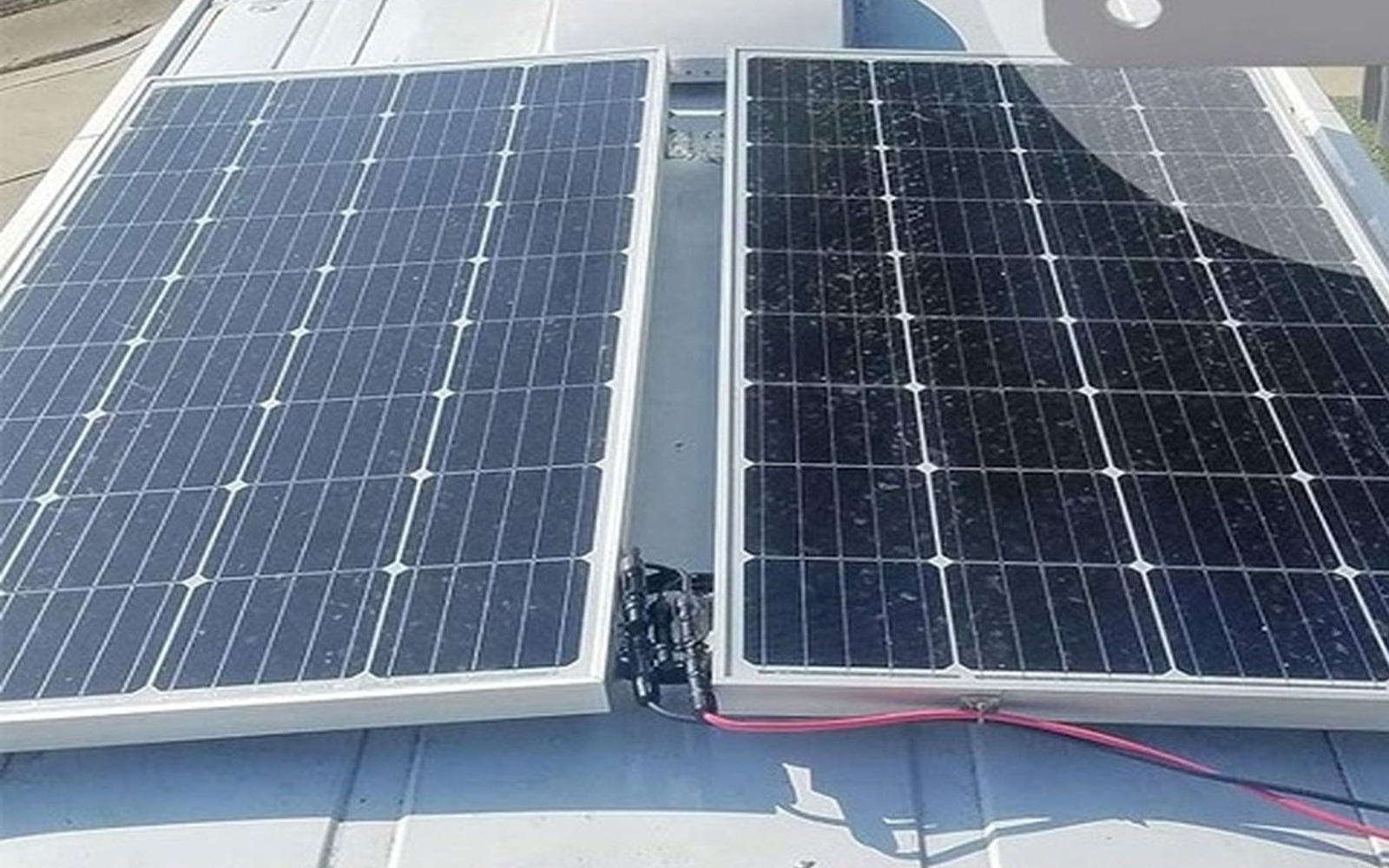
- Panels — two of our 160 W flexible panels rather than one 300 W. Easier to place around roof furniture, and shading one does not take the whole array down. Where the roof has a genuinely flat clear section and weight is not critical, a rigid 160 W is the longer-lived choice — 5 year full warranty against 1 year for a flexible laminate.
- Brackets — our ABS bracket sets in 6 or 7 pieces for panels this size. Bonded, no drilling; the roof skin stays intact and the installation is reversible when the vehicle is sold.
- Controller — a 30 A MPPT. At 320 W of array a PWM controller throws away a meaningful share of the harvest, and the gap is widest in cold bright weather — exactly the shoulder-season conditions where a motorhome owner notices.
- Battery — 100 Ah LiFePO4. Two days of autonomy at this consumption, and unlike lead-acid you can actually use most of the capacity.
- Inverter — a 500 W pure sine wave covers laptops, chargers and small appliances. Step up to 1000 W if there is a coffee machine in the conversation.
Three things worth getting right
- Leave 20–30 mm between panels. Airflow and drainage. Panels butted together trap water and grit, and run hotter.
- Wire around the shading, not into it. If one panel will be shaded by the air conditioner in the afternoon, keep it on its own controller input or accept that it will drag the others down.
- Check the battery can take the charge current. A large array into a battery with a modest charge limit is money spent on nothing. We check this pairing before quoting.
Why it matters that we make the brackets
Motorhome roofs are where mounting goes wrong most often, because there is enough space to be careless with. The brackets are the part we tool and manufacture ourselves — so when you ask whether a 7-piece set suits a 1500 mm panel on a slightly curved roof section, you get an answer from the people who made the part, not a message forwarded to a factory.
Tell us the vehicle, the usable roof area between obstacles, and your daily consumption in watt-hours — we will come back with a configuration and a price. If you would rather do the sizing yourself first, the arithmetic is on the FAQ page. Request a quotation →
Measure between the obstacles, not across the roof
Send us the usable rectangles and the daily consumption. We come back with a panel layout, a controller that matches it, and the bracket count to hold it down.
Get a system spec