
The brackets do not need holes. The cable usually does — one of them, in a place you choose, sealed once and never touched again. That is the honest version of “no drilling“, and it is worth setting out properly, because the two questions get run together and buyers notice when a supplier only answers the comfortable half.
These are two different problems
Mounting is about load. A panel has to stay put at motorway speed, through heat cycling and vibration, for years. That load can be carried by an adhesive bond across a large area, which is why bonded bracket sets became the mainstream method — the roof skin under the panel stays closed.
Cable entry is about a pass-through. The DC has to reach the controller, and the controller is inside. No amount of clever mounting changes that. So the question is not whether you can avoid every hole; it is whether you end up with one deliberate, properly made entry instead of four or six fixing holes plus an entry.
Three routes in, in the order we would try them
- An entry you already have. An existing roof gland, a vent collar, a redundant aerial hole, sometimes a fridge vent. The best hole in a roof is one that is already there and already sealed. Check before you buy anything — it changes which bracket set you need.
- A new entry under a cable entry housing. One hole, with a housing bonded over it that takes the cables through glands and keeps standing water off the opening. Our five- and seven-piece ABS sets include a twin-gland cable entry housing for exactly this.
- Around the edge, through a door or window frame. It sounds like the clever answer and it ages badly. Those seals are designed to compress on a moving joint; a cable run through one is a long-term leak and a chafe point.
If you do make a hole, make it once
- Deburr and treat the edge. A freshly cut hole is bare metal. It is the one part of the job that is invisible afterwards and the one that decides whether you get corrosion around the entry in three winters.
- Neutral-cure silicone, not acetoxy. Acetoxy sealant releases acetic acid as it cures — the vinegar smell — and that attacks metal and electrical contacts. It is the cheap tube in most hardware shops. The sealant in our accessory pack is neutral-cure for this reason, not as a specification flourish.
- Bond the housing the way you bonded the brackets. Same surface preparation, same tape, sealed at the edges. A housing that lifts is worse than no housing, because it holds water against the hole.
- Leave a drip loop. The cable should arrive at the gland from below the entry point, so water runs off the low point of the loop instead of tracking along the sheath and into the hole. This costs nothing and prevents a whole category of leak.
The failure we actually hear about is not the hole
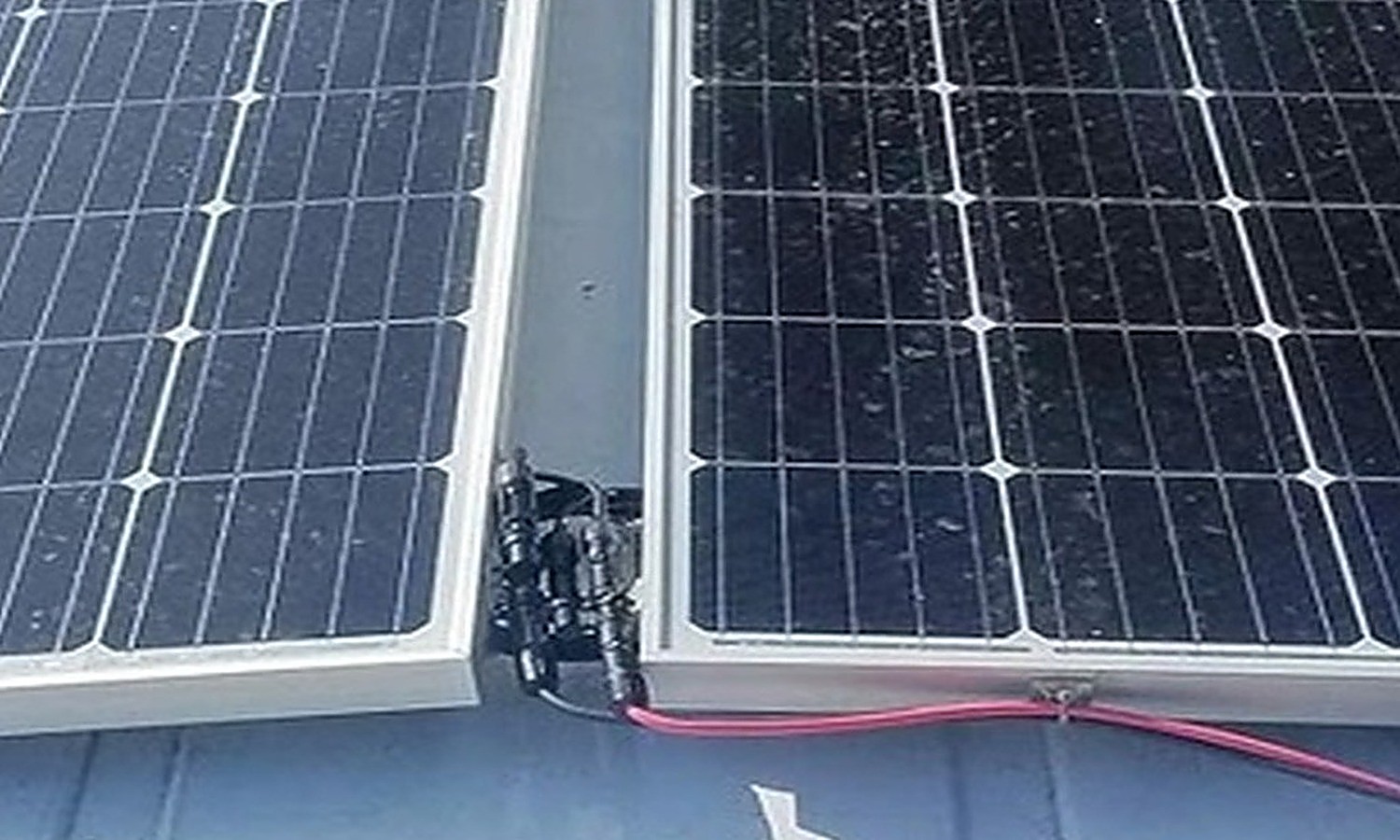
When an installation comes back to us with a problem, it is rarely the entry itself. It is the cable. Unsupported cable flogs against the roof at speed and wears through its sheath. A connector left lying on the roof sits in every puddle the vehicle collects. A run pulled tight across a sharp panel edge chafes quietly for a season and then shorts.
Clip the run down at sensible intervals, keep MC4 joints off the roof surface rather than resting in them, and leave enough slack that nothing is under tension when the body flexes. None of that is expensive. All of it is the difference between an installation you forget about and one you revisit.
What we supply for this part of the job
- ABS bracket sets in five and seven pieces, which include the twin-gland cable entry housing. The four and six-piece sets do not — they are for roofs that already have an entry.
- An installation accessory pack: genuine 3M VHB tape and neutral-cure sealant, so the entry and the brackets go on with the same materials.
- Cable kits made up with MC4 and Anderson connectors, in lengths sized for a roof-to-controller run.
Tell us the vehicle and whether there is already a gland in the roof, and we will say which set you need. That includes telling you the four-piece is enough when it is — there is no sense selling you a cable entry housing for a hole you already have.
Have a question about your build?
Tell us the vehicle, the roof dimensions and your daily consumption. We will size the system and quote it — and say so if what you are asking for will not work.