
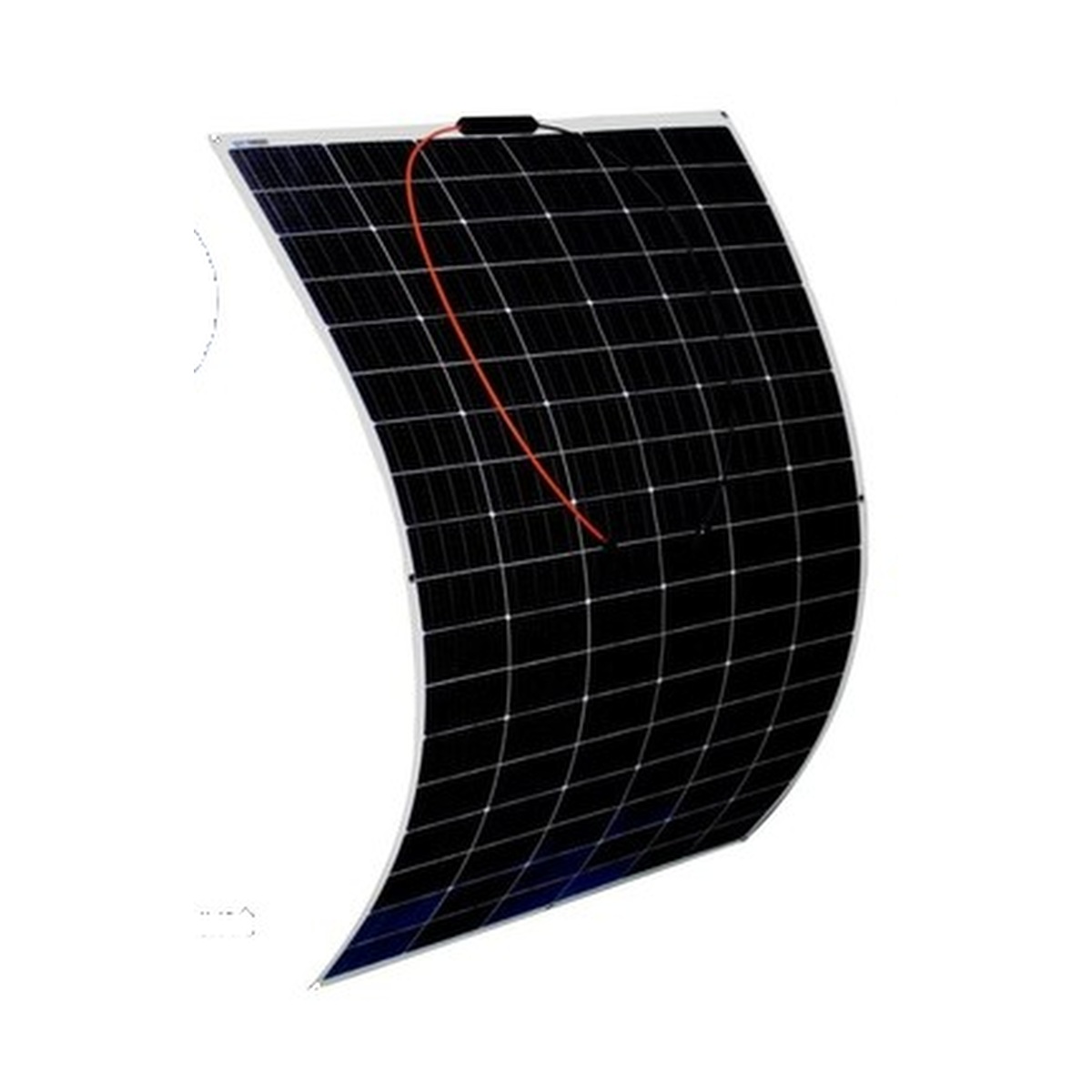
No. Not once, not carefully, not “just to reach the aerial”. A flexible panel is a 3 mm laminate, not a walking surface, and the damage you do by standing on one is usually invisible at the time and permanent afterwards. We sell these panels. We would still rather you planned the roof properly than found this out in year two.
What is actually under your foot
A framed glass panel is silicon cells laminated behind tempered glass in an aluminium frame. The glass spreads load and the frame carries it to the mounting points. That is why some rigid panels are rated as walk-on and are sold to boatyards on that basis.
A flexible panel has neither. It is the same brittle silicon, laminated between thin polymer sheets — an ETFE or PET front sheet, a backing, and nothing rigid in between. Total thickness around 3 mm. It is designed to follow the gentle curve of a vehicle roof and to weigh almost nothing. Those two properties are the whole point of it, and they are the same two properties that make it unsuitable for taking your weight.
The damage you will not see
This is the part that catches people out. Silicon cells crack long before the laminate shows anything. Step on a panel and you can lift your foot to find it looking exactly as it did before — no dent, no mark, no crunch. The cell underneath has cracked.
- Output falls, slowly and without an obvious cause. A cracked cell keeps working at reduced output, and because the cells in a panel are in series, one bad cell drags the string it sits in.
- It gets worse with heat cycling. A hairline crack opens and closes every day the roof heats and cools. What was a small loss in month one is a larger one by the second summer.
- There is nothing to repair. The cells are sealed inside a laminate. Unlike a framed panel, you cannot replace a piece of glass or a junction box and carry on.
“But mine is bonded flat to the roof”
It is a fair question, and it deserves a straight answer rather than a blanket no. A panel bonded directly to a roof skin is better supported than one sitting on a raised frame — the load has somewhere to go instead of flexing the laminate across a span.
That helps. It does not make the panel walk-on. A vehicle roof is not a flat, continuous surface: there are ribs, there are soft bays between them, and there is usually a slight crown. Your weight goes through the sole of one boot into whatever is directly beneath it, and if that happens to be a bay between ribs, the panel flexes exactly as much as the roof does. We are not going to tell you a bonded panel is safe to stand on, because we do not know what is under it on your vehicle.
Plan the roof so that you never have to
- Leave a corridor. Decide where you will walk before you decide where the panels go, not after. On most vans that means keeping one side or the centre line clear.
- Put the panels where the jobs are not. Roof lights, aerials, air conditioners and vents all need reaching eventually. Panels should sit away from them, not around them.
- Work from the edge. Most roof maintenance on a van can be done from a step ladder at the side. It is slower and it is the reason your panels still make full output in year five.
- If the roof genuinely has to be walked on, that is a rigid-panel conversation with a proper raised frame and defined walkways — not a flexible laminate. Tell us that up front and we will say so.
When you send us the vehicle and the roof layout, this is one of the things we check. It is also why we ask for the dimensions between your roof furniture rather than just the panel wattage — the fit and the access are the same problem.
If it has already happened
Do not assume the panel is finished. Measure it: open-circuit voltage in full sun, and short-circuit current, compared against the panel’s rating and against the other panels in the array if you have them. A cracked cell usually shows as a current shortfall rather than a voltage one. If the numbers are close to specification, carry on and re-measure next season. If one panel in a string is dragging the others, wiring it in parallel rather than in series limits the damage to that panel — the reasoning is in our series or parallel guide.
Have a question about your build?
Tell us the vehicle, the roof dimensions and your daily consumption. We will size the system and quote it — and say so if what you are asking for will not work.